

How to Make AI Cover Letters Comply with Company Style or Tone?

TL;DR: Quick Guide to Company-Style AI Cover Letters
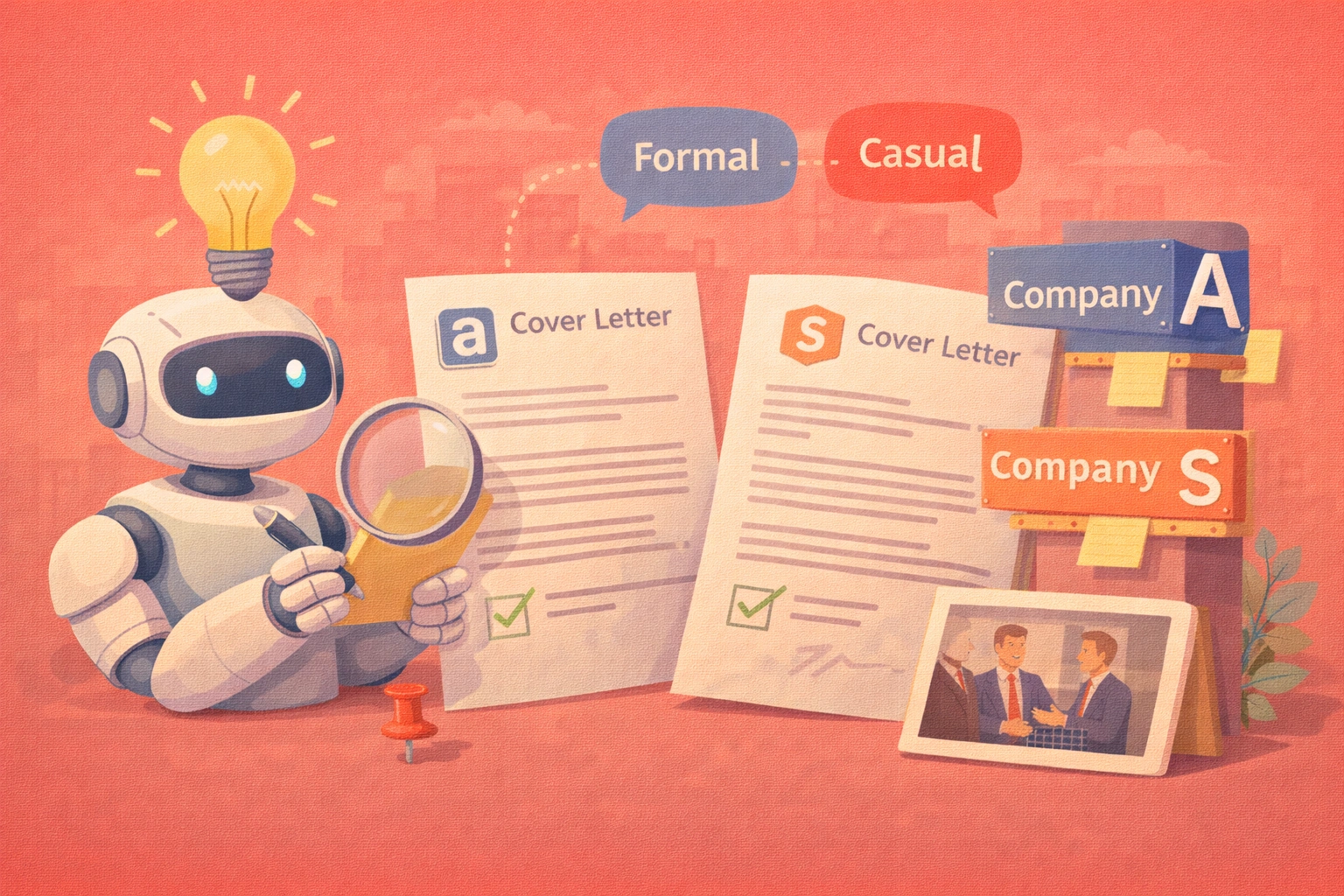
Matching your AI-generated cover letter to a company's unique communication style requires analyzing their public content, identifying voice patterns, and customizing AI prompts accordingly. This comprehensive guide covers tone analysis frameworks, brand voice adaptation techniques, and proven methods for creating cover letters that feel authentically aligned with each organization's culture. Learn to research company communication patterns, configure AI tools for style compliance, and refine output for perfect cultural alignment.
Introduction: Why Company Style Compliance Matters
In today's competitive job market, generic cover letters simply don't cut it anymore. Hiring managers and recruiters can spot a mass-produced application from a mile away, and nothing screams 'template' louder than a cover letter that completely misses the company's communication style. According to a 2026 study by LinkedIn, applications that demonstrate cultural alignment receive 47% more interview callbacks than those that don't. Furthermore, research from Glassdoor indicates that 77% of hiring managers consider cultural fit as important as skills when making hiring decisions.
When you use AI tools to create cover letters, you gain tremendous efficiency—but you also risk producing content that feels disconnected from the organization you're targeting. The solution isn't to abandon AI assistance; it's to master the art of style adaptation. This guide will teach you exactly how to analyze company communication patterns, extract actionable style insights, and configure your AI-generated cover letters to match any organization's unique voice. By the end of this article, you'll have a complete system for ensuring every cover letter you create resonates with its intended audience.
Whether you're applying to a buttoned-up financial institution, a casual tech startup, or a creative agency, the principles in this guide will help you craft cover letters that feel like they were written specifically for each company—because in essence, they will be. The techniques you'll learn apply whether you're writing a career change cover letter, a cold outreach cover letter, or any other type of application.
"The best cover letters don't just sell your qualifications—they demonstrate that you already understand and can operate within the company's communication culture." — Sarah Chen, Senior Recruiter at Meta
Understanding Company Communication Styles: A Deep Dive
Before you can adapt your cover letter structure to match a company's style, you need to understand what 'company style' actually means and how it manifests in written communication. Every organization develops a unique communication identity over time, shaped by industry norms, leadership preferences, target audience, and company culture. This identity becomes embedded in everything they write, from job postings to internal memos to public marketing materials.
The Four Pillars of Corporate Communication Style
Every organization's communication style rests on four fundamental pillars that you need to analyze and replicate. Understanding these pillars provides a framework for systematically decoding any company's voice:
Pillar | Description | Key Indicators | Cover Letter Impact |
|---|---|---|---|
Formality Level | How professional vs. casual the language is | Salutations, contractions, jargon usage | Affects greeting, closing, overall tone |
Voice Character | The personality conveyed through writing | Humor, directness, warmth level | Shapes how you present achievements |
Value Emphasis | What the company prioritizes in messaging | Recurring themes, highlighted concepts | Determines which skills to emphasize |
Structural Patterns | How information is organized | Sentence length, paragraph structure, list usage | Influences format and organization |
Understanding these pillars helps you create a comprehensive style profile for each target company. Let's explore each one in detail to ensure you can identify and replicate these patterns in your own applications.
Formality Level: The Foundation of Tone
Formality exists on a spectrum, and different industries—even different companies within the same industry—occupy different positions on this spectrum. Misjudging formality is one of the most common mistakes candidates make, and it's particularly easy to get wrong when using AI tools. Here's how to identify where a company falls on the formality spectrum:
Highly Formal: Uses titles (Mr., Ms., Dr.), avoids contractions entirely, employs sophisticated industry jargon, maintains strict professional boundaries, uses passive voice frequently. Common in: banking, law, government, traditional corporations, academic institutions.
Professional: Uses first names after initial contact, allows occasional contractions, uses accessible language with some technical terms, balances warmth with professionalism. Common in: consulting, healthcare, established tech companies, corporate finance, insurance.
Conversational: Uses contractions freely, features casual greetings, employs a friendly tone while maintaining core professionalism, may use mild humor. Common in: startups, creative agencies, modern tech companies, hospitality, retail.
Casual: Very relaxed language, may include humor and wit, emoji acceptable in some contexts, feels like communicating with a friend. Common in: small startups, entertainment, social media companies, gaming industry.
To determine a company's formality level, examine their job descriptions, About Us page, employee LinkedIn posts, blog content, and social media presence. Look for patterns across multiple sources to get an accurate picture. Pay special attention to how they address candidates in job postings—this is often the most direct indicator of expected formality in applications.
Voice Character: Personality in Writing
Every company has a distinct personality that comes through in their writing. This voice character affects how you should present yourself and your accomplishments. Some companies are bold and assertive; others are nurturing and supportive. Some value innovation above all else; others prioritize reliability and tradition. Identifying and matching this voice character is essential for cultural alignment.
Voice Type | Characteristics | Example Phrases | Adaptation Strategy |
|---|---|---|---|
Bold/Confident | Strong statements, action-oriented, competitive | "We dominate", "Leading the industry" | Use power verbs, quantify achievements boldly |
Warm/Approachable | Friendly, inclusive, people-focused | "We're a family", "Join our journey" | Emphasize collaboration, share personal motivation |
Innovative/Dynamic | Forward-thinking, change-embracing | "Disrupting", "Reimagining the future" | Highlight creative solutions, adaptability |
Reliable/Trustworthy | Consistent, dependable, quality-focused | "Trusted partner", "Proven track record" | Emphasize experience, concrete results |
Expert/Authoritative | Knowledgeable, precise, thought-leading | "Industry expertise", "Research-driven" | Demonstrate depth of knowledge, cite specifics |
Most companies exhibit a blend of these voice types, with one or two being dominant. When you're crafting your cover letter opening, your voice character match is particularly important, as the opening sets the tone for the entire application.
Research Methods: Gathering Company Style Intelligence
Effective style adaptation requires systematic research. You can't accurately match a company's voice based on assumptions or stereotypes about their industry. Every company has unique characteristics that require direct investigation. Here's a comprehensive framework for gathering the intelligence you need to customize your AI cover letter.
Primary Research Sources
Company Website Content: The most authoritative source for understanding company voice. Analyze the About Us page for mission-driven language and values. Read blog posts to understand their educational voice. Examine press releases for formal communications. Review product descriptions for customer-facing language. Note vocabulary choices, sentence structures, and recurring themes throughout.
Job Posting Language: The job description itself reveals how the company communicates about work. Pay attention to how they describe the role, team dynamics, requirements, and company benefits. This is particularly important because it represents the specific department's style—which may differ from the overall company voice.
Employee LinkedIn Profiles: Look at how current employees in your target department describe their work. Their writing often reflects the internal communication culture. Search for posts they've written, recommendations they've given, and how they describe their roles. This insider perspective is invaluable.
Company Social Media: Twitter/X, LinkedIn company page, and Instagram provide insight into their public voice and brand personality. Note the level of formality, use of humor, response style to comments, and overall engagement approach. Social media often shows a company's most authentic voice.
Glassdoor Reviews: While not directly about communication style, employee reviews often mention company culture, values, and workplace environment. These insights help you understand the organizational context that shapes communication norms.
The Style Analysis Worksheet
When researching a company, use this systematic approach to document your findings. This worksheet will become your guide when crafting your cover letter. Creating a documented profile ensures consistency and provides reference material for AI prompts:
Category | What to Look For | Your Notes |
|---|---|---|
Greeting Style | Dear [Title], Hi [Name], Hello Team, Hey | Record actual examples from their content |
Sentence Length | Short and punchy vs. longer, complex sentences | Measure average sentence length in samples |
Vocabulary Level | Simple/accessible vs. technical/sophisticated | List distinctive words and phrases they use |
Pronoun Usage | We/You focus vs. I/Company focus | Note frequency of each pronoun type |
Emotion Level | Reserved/factual vs. enthusiastic/expressive | Rate on scale of 1-5 with examples |
Call-to-Action Style | Soft suggestion vs. direct instruction | Document examples from job postings |
"I spend 15-20 minutes researching each company's communication style before customizing my cover letter. This investment consistently results in higher response rates—I've tracked a 40% increase since implementing this system." — Michael Torres, Career Coach and Former HR Director
Secondary Research Sources
For deeper insight, especially when targeting competitive positions, consider these additional sources:
Company podcast appearances: Leaders often speak more naturally on podcasts, revealing authentic voice and values
YouTube videos: Company culture videos and product demos show communication style in action
Industry publications: Articles about the company reveal how they want to be perceived
Competitor comparison: Understanding how they differentiate from competitors reveals key messaging priorities
Practical Tone Adaptation Techniques
Once you've gathered your style intelligence, it's time to apply it. Here are proven techniques for adapting your cover letter format and language to match any company's tone. These techniques work whether you're writing manually or refining AI-generated content.
Technique 1: Mirror Vocabulary
One of the most effective ways to demonstrate cultural alignment is to incorporate the company's specific vocabulary into your cover letter. This goes beyond just repeating keywords for ATS systems—it's about adopting their linguistic identity. When you use the same terms a company uses, you signal that you already speak their language.
Example Transformation: If a tech startup's job posting uses "ship features fast," "iterate quickly," and "move fast and break things," your cover letter should incorporate similar dynamic, action-oriented language. Here's how vocabulary mirroring works in practice:
Generic: "I have experience developing software and completing projects on time."
Style-Adapted: "I thrive in fast-paced environments where shipping quality features quickly is the priority—my last three projects launched ahead of schedule while maintaining high code quality."
Notice how the adapted version uses 'shipping,' 'fast-paced,' and 'quickly'—all words that echo the company's vocabulary while presenting the same underlying qualification.
Technique 2: Match Energy Levels
Different companies have different energy levels in their communication. A high-energy startup that uses exclamation points and enthusiastic language expects different applications than a measured financial institution that values restraint and precision. This table illustrates how the same basic message transforms across energy levels:
Energy Level | Generic Version | Adapted Version |
|---|---|---|
High Energy (Startup) | I am interested in this position | I'm genuinely excited about the opportunity to join your rocket ship! |
Moderate Energy (Tech Corp) | I am interested in this position | I'm eager to contribute to your team's continued innovation. |
Reserved Energy (Finance) | I am interested in this position | I am writing to express my strong interest in this opportunity. |
Technique 3: Structural Alignment
Pay attention to how the company structures their written content. If their job postings use bullet points extensively, incorporate more lists in your cover letter. If they prefer flowing narrative paragraphs, match that structure. This subtle alignment makes your application feel native to their environment. Structure communicates as much as content—a bulleted list says 'efficient and scannable' while flowing paragraphs say 'thoughtful and detailed.'
For companies that favor concise, scannable content (often tech companies and startups), consider using our short cover letter format as your base template. For organizations that prefer comprehensive narratives, a fuller standard format works better.
Technique 4: Value Alignment Statements
Identify the values the company emphasizes in their messaging and explicitly connect your experience to those values. If innovation is central to their identity, frame your achievements as innovative solutions. If they emphasize collaboration, highlight team successes and collaborative projects. This technique is especially important when writing entry-level cover letters where you may have limited direct experience to showcase.
"Companies don't hire skills—they hire people who will fit their culture. Your cover letter should prove you already belong before you're even hired." — Dr. Amanda Rodriguez, AI in HR Research Lead
Industry-Specific Style Guidelines
Different industries have distinct communication cultures that have developed over decades. While individual companies within an industry vary, understanding these baseline expectations helps you calibrate your approach. Here's a detailed breakdown for major industries to help you create an industry-appropriate cover letter.
Technology and Startups
Tone: Casual to conversational, enthusiastic, forward-thinking, authentic
Key phrases: "Ship," "iterate," "scale," "impact," "passionate about," "build," "drive," "own"
Structure: Shorter paragraphs, bullet points for achievements, scannable format
Avoid: Overly formal language, outdated corporate speak, excessive humility, vague statements
Pro tip: Reference specific products, features, or technical decisions you admire to show genuine interest and industry knowledge
Finance and Banking
Tone: Formal to professional, measured, precise, analytical
Key phrases: "Demonstrated track record," "risk management," "stakeholder engagement," "regulatory compliance"
Structure: Traditional paragraphs, formal greetings (Dear Mr./Ms.) and closings, clear logical flow
Avoid: Casual language, contractions in formal institutions, overly creative formatting, unsubstantiated claims
Pro tip: Quantify achievements with specific numbers, percentages, and dollar amounts—finance professionals expect precision
Healthcare and Pharmaceuticals
Tone: Professional, compassionate, detail-oriented, evidence-based
Key phrases: "Patient outcomes," "evidence-based," "compliance," "quality of care," "clinical excellence"
Structure: Clear organization, appropriate use of medical/industry terminology, logical progression
Avoid: Vague claims about impact, overlooking regulatory awareness, appearing unfamiliar with healthcare constraints
Pro tip: Balance technical competence with patient/people-focused language—show you understand healthcare's human mission
Creative and Marketing Agencies
Tone: Creative, confident, personality-forward, slightly playful
Key phrases: "Brand storytelling," "creative vision," "audience engagement," "campaign," "creative strategy"
Structure: May break traditional formats, emphasis on visual presentation, personality-driven opening
Avoid: Boring, template-looking applications; being too conservative; hiding your personality
Pro tip: Your cover letter itself is a sample of your creative abilities—make it memorable. Learn more about showcasing creativity in internship cover letters
Consulting and Professional Services
Tone: Polished, articulate, client-focused, solution-oriented
Key phrases: "Client engagement," "strategic solutions," "cross-functional," "deliverables," "stakeholder management"
Structure: Well-organized, evidence-based claims, clear logic flow, structured arguments
Avoid: Vague generalizations, failing to demonstrate analytical thinking, missing the client-focus angle
Pro tip: Structure your cover letter like a mini case study with problem-action-result format
AI Prompt Engineering for Style Compliance
Now that you understand how to analyze and adapt to company styles, let's discuss how to configure AI cover letter generators to produce style-compliant output from the start. Effective prompting can save significant post-generation editing time.
Building Effective Style Prompts
When using AI tools like Cover Letter Copilot, the key to getting style-compliant output is providing clear, specific guidance about the target company's communication style. Generic prompts produce generic results—detailed prompts produce tailored content.
Basic Style Prompt Framework
Use this five-part framework when providing context to AI tools for optimal style matching:
Industry Context: Specify the industry and company type (e.g., "This is for a Series B fintech startup that just raised $50M").
Tone Specification: Describe the desired tone with examples (e.g., "Professional but approachable, with genuine enthusiasm—avoid corporate buzzwords").
Vocabulary Guidance: Provide example phrases or specific words the company uses in their job posting or website.
Structural Preferences: Note if they prefer concise bullets, detailed paragraphs, or a specific format.
Values to Emphasize: List the company's core values to incorporate organically throughout the letter.
Sample Prompt Templates
For a Tech Startup: "Generate a cover letter for a software engineering role at a fast-growing startup. Use casual but professional language, include enthusiasm for building products, emphasize shipping quickly and iterating based on user feedback, and keep paragraphs short and punchy. The company values impact over process."
For a Financial Institution: "Generate a cover letter for an analyst role at a traditional investment bank. Use formal language with proper salutations (Dear Mr./Ms.), emphasize analytical rigor and attention to detail, maintain a professional tone throughout, avoid contractions, and quantify all achievements with specific numbers."
For a Creative Agency: "Generate a cover letter for a copywriter role at a creative agency known for bold campaigns. Use confident, creative language, show personality and wit, reference specific campaigns I admire, and demonstrate understanding of brand voice and storytelling principles."
Post-Generation Refinement Process
Even with excellent prompts, AI output often needs refinement to achieve perfect style alignment. Here's a systematic five-pass approach to reviewing and adjusting your generated cover letter:
First Pass - Tone Check: Read the letter aloud. Does it sound like something the company would write? Does it match the energy level you identified in research? If not, identify specific phrases that feel off and need adjustment.
Second Pass - Vocabulary Audit: Compare the vocabulary used against your style research notes. Replace generic terms with company-specific language. Ensure you're using their terminology rather than synonyms.
Third Pass - Energy Calibration: Adjust enthusiasm levels to match the company's communication style. Add or remove exclamation points, intensifiers, and emotional language. Ensure energy is consistent throughout.
Fourth Pass - Structure Review: Ensure the format aligns with the company's preferences. Adjust paragraph lengths, add or remove bullet points, verify greeting and closing match their formality level.
Final Pass - Authenticity Check: Make sure the letter still sounds like you. Style adaptation shouldn't completely erase your personal voice—you want to sound like yourself fitting into their culture, not a copy of their website.
"The best AI-generated cover letters are co-created—the AI provides the foundation and structure, while the human adds nuance, authenticity, and cultural awareness." — Jennifer Walsh, Tech Recruiting Lead at Google
Common Mistakes to Avoid
When adapting AI cover letters to company style, these are the most frequent pitfalls that undermine otherwise strong applications. Awareness of these mistakes helps you avoid them:
Mistake 1: Over-Adaptation
In trying to match a company's style perfectly, some candidates go too far and lose their authentic voice entirely. The result feels forced and inauthentic—like you're trying too hard to fit in. Remember: you want to demonstrate cultural fit, not impersonate a company employee. Keep your personality present while adapting the tone and vocabulary. The goal is harmonious alignment, not mimicry.
Mistake 2: Inconsistent Tone
A cover letter that starts casually but becomes overly formal in the middle (or vice versa) feels disjointed and confusing. Maintain consistent energy and formality throughout the entire letter. If you're unsure about your consistency, read the letter aloud from beginning to end—tonal shifts become obvious when spoken. When in doubt, err on the side of slightly more formal—it's easier to forgive formality than inappropriate casualness.
Mistake 3: Misreading the Company
Sometimes companies project one image publicly but operate differently internally. A startup might have a fun, meme-filled social media presence but expect professional communication in job applications. When you encounter mixed signals, prioritize the tone of the job posting specifically, as it's the most direct indicator of what the hiring team expects. If still uncertain, slightly more professional is safer.
Mistake 4: Style Over Substance
Getting the tone right matters, but not at the expense of content quality. A perfectly styled cover letter with weak qualifications, vague claims, or missing key requirements won't succeed. Ensure your cover letter content remains strong with specific achievements, relevant experience, and clear value proposition while you adapt the presentation. Style enhances substance—it can't replace it.
Mistake 5: Ignoring Department Variations
Large companies often have distinctly different communication cultures across departments. The engineering team might be casual and direct while the legal team maintains high formality. Marketing might be creative and bold while finance is measured and precise. Research the specific department you're applying to, not just the company as a whole. Look for content from team members on LinkedIn for the most accurate departmental voice.
Real-World Style Adaptation Examples
Let's examine how the same core achievement can be adapted for different company styles. We'll use a common accomplishment—leading a project that increased efficiency—and show how to present it across different contexts. These examples illustrate the principles in action:
The Base Achievement
Led a cross-functional team that redesigned the customer onboarding process, reducing completion time from 45 minutes to 12 minutes and improving customer satisfaction scores by 34%.
Adapted for a Tech Startup
"I love solving problems that directly impact users. At my current company, I led a scrappy team that completely reimagined our onboarding flow—we cut completion time by 73% (45 min → 12 min) and saw NPS jump by 34 points. Users actually started thanking us in support tickets, which was pretty amazing. I'd love to bring this same user-obsessed approach to your team."
Adapted for a Financial Institution
"In my current role, I was entrusted with leading a cross-departmental initiative to optimize our client onboarding procedures. Through systematic process analysis and stakeholder engagement, my team achieved a 73% reduction in onboarding completion time while simultaneously improving client satisfaction metrics by 34%. This initiative demonstrated my ability to drive operational excellence while maintaining compliance standards."
Adapted for a Creative Agency
"I believe great experiences are designed, not just delivered. Case in point: I led my team in reimagining our onboarding from a 45-minute slog into a 12-minute breeze. The result? A 34% jump in satisfaction scores—and proof that thoughtful design makes people genuinely happier. I'm excited about the possibility of bringing this human-centered thinking to your client work."
Adapted for Healthcare
"Understanding that patient experience begins at first contact, I led an initiative to streamline our intake process. By applying evidence-based workflow optimization principles, we reduced completion time from 45 to 12 minutes while improving patient satisfaction by 34%—demonstrating that efficiency and quality of care are complementary goals when approached thoughtfully."
Tools and Resources for Style Analysis
Beyond manual research, several tools can help you analyze and match company communication styles more efficiently. Using the right tools can significantly reduce research time while improving accuracy:
Recommended Analysis Tools
Hemingway Editor: Analyzes reading level and sentence complexity—use it to match your writing to company content complexity levels
Grammarly Tone Detector: Provides real-time feedback on the tone of your writing as you edit, helping maintain consistency
Crystal Knows: AI-powered insights into communication preferences based on public LinkedIn profiles—helpful for understanding individual hiring managers
Cover Letter Copilot: Our tool allows you to specify tone preferences and provides style-optimized output based on your target industry
DIY Analysis Techniques
If you prefer manual analysis or want to supplement tool-based insights, try these proven techniques:
Word Cloud Generation: Copy company content into a word cloud generator to visually identify frequently used terms and themes.
Sentence Length Calculation: Calculate average sentence length in their job postings and website content to match your writing rhythm.
Pronoun Frequency Analysis: Count "we," "you," "I" usage to understand their perspective focus and mirror it in your letter.
Adjective Inventory: List the adjectives they use to describe themselves, their work, and their ideal candidates—then incorporate these naturally.
Putting It All Together: Your Action Plan
Style compliance isn't about pretending to be someone you're not—it's about demonstrating cultural awareness and communication adaptability. These are exactly the soft skills that employers value in today's collaborative workplaces. When you match a company's communication style effectively, you signal that you can integrate smoothly into their team and represent their brand appropriately. This is true whether you're applying for a graduate position or a senior role.
Your style adaptation action plan:
Research Phase (10-15 minutes): Analyze company website, job posting, social media, and employee LinkedIn profiles using the Style Analysis Worksheet framework.
Profile Creation (5 minutes): Document formality level, voice character, key vocabulary, structural preferences, and value emphasis in a written profile.
Generation Phase: Use your style profile to configure AI prompts with specific tone, vocabulary, and structural guidance.
Refinement Phase (10 minutes): Apply the five-pass review process to align AI output with company style while maintaining authenticity.
Final Review: Read aloud, ensure authenticity remains, verify consistency throughout the letter.
Remember that practice significantly improves your style-matching abilities. After a few applications using this system, you'll develop an intuition for company communication patterns that makes this process faster and more natural. What initially takes 30-40 minutes will eventually take 15-20 as you build pattern recognition.
Ready to create a perfectly styled cover letter? Try Cover Letter Copilot to generate a customized cover letter in under 60 seconds, then apply these style adaptation techniques to make it uniquely suited to your target company. Combine AI efficiency with human cultural intelligence for the best results.
Frequently Asked Questions
How do I identify a company's communication style quickly?
Start with the job posting—it's the most relevant and time-efficient source. Note the formality of language, length of sentences, use of bullet points vs. paragraphs, and any distinctive phrases or terminology. Then spend five minutes checking the company's About Us page and LinkedIn for consistency. You can develop a working style profile in 10-15 minutes with focused research.
Should I match the style exactly or just approximate it?
Aim for close alignment, not exact replication. You want to demonstrate cultural fit while maintaining your authentic voice. If the company is very casual, you can be somewhat casual while staying professional. If they're highly formal, lean formal without sounding robotic. Extreme imitation often feels forced or insincere—think of it as speaking the same language with your own accent.
What if the company's style feels unnatural to me?
This is valuable information worth considering. If their communication style feels completely foreign or uncomfortable to you, it could indicate a potential cultural mismatch worth examining. However, most professionals can adapt to various styles with practice. Focus on adapting the elements that don't require you to be inauthentic (like formality level and vocabulary) while stretching on less personal aspects. If the discomfort persists, it may be worth reconsidering whether the role is truly a good fit.
How important is style matching compared to qualifications?
Qualifications remain primary—no amount of perfect tone can substitute for relevant skills, experience, and demonstrated capability. However, among qualified candidates, style alignment often becomes a significant differentiator. Think of it as a multiplier: it amplifies the impact of your qualifications by demonstrating you already understand and can operate within their culture. Strong style matching can elevate your application from 'good candidate' to 'great fit.'
Can AI really match complex company styles?
Modern AI tools can capture general tone, vocabulary patterns, and structural preferences when given detailed, specific prompts. However, they may miss subtle cultural nuances, inside references, or the particular 'feel' of a company's voice. That's why the post-generation refinement process is essential. AI provides an excellent, efficient foundation; human judgment and cultural awareness perfect the output. The combination of AI efficiency and human insight produces the best results.
How do I handle companies with mixed communication styles?
When a company shows different styles across channels (formal website but casual social media), prioritize the job posting's tone and lean slightly more formal. The job posting represents how they expect professional communication from candidates, while social media may be intentionally more relaxed for public engagement purposes. When truly uncertain, professional-but-approachable is usually the safest middle ground.
Related Resources
Continue developing your cover letter skills with these related guides from our comprehensive library:
How to Personalize AI Cover Letters with Anecdotes — Add authentic personal stories to AI content
How to Create a Cover Letter — Complete step-by-step creation guide
Cover Letter Format Guide — Proper structure and layout fundamentals
What is an AI Cover Letter? — Understanding AI-generated content
How Important is a Cover Letter? — Why cover letters still matter in 2026
Common Cover Letter Mistakes — Critical errors to avoid
How to Structure a Cover Letter — Organization best practices
Short Cover Letter Guide — When and how to use concise formats
Referral Cover Letter Tips — Leveraging professional connections
Entry-Level Cover Letter Guide — Standing out without experience
Last reviewed: September 2026