

How to Optimize AI Cover Letters for Recruiter Scans?

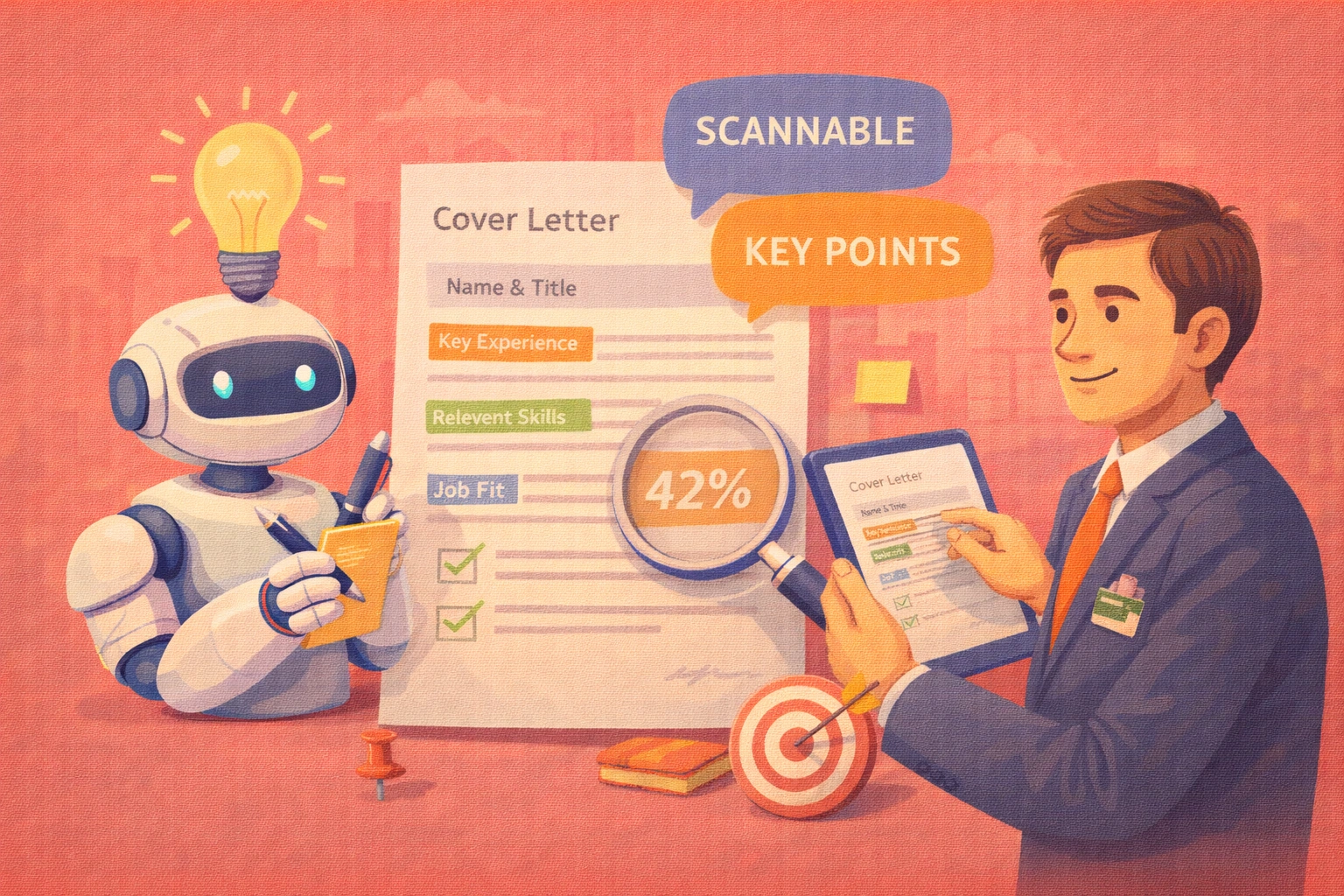
TL;DR - Quick Answer
Optimizing AI cover letters for recruiter scans requires understanding both ATS (Applicant Tracking System) algorithms and human recruiter scanning patterns. Focus on strategic keyword placement from the job description, clear formatting with standard fonts, quantified achievements in the first two paragraphs, and removing generic AI phrases that trigger rejection. The most effective approach combines AI efficiency with human-style personalization.
Recruiters spend an average of 6-7 seconds on initial cover letter scans—your AI-generated letter needs to pass both automated screening and capture human attention instantly. When you understand how to test AI cover letters against ATS software, you can ensure your applications survive the first filter. The key is creating content that reads naturally while incorporating the specific terms and qualifications that both algorithms and humans seek.
Key Takeaways
Keyword optimization is essential: Mirror exact phrases from job descriptions—ATS systems match literal terms, not synonyms.
Front-load your value: Place your strongest qualifications and achievements in the first 100 words where recruiter eyes land first.
Format for scannability: Use standard fonts, clear headers, and bullet points that both ATS and humans can parse quickly.
Remove AI detection flags: Edit out generic phrases, passive voice, and overly formal language that signals automated generation.
Quantify everything possible: Numbers and metrics grab attention during quick scans—"increased sales 40%" beats "improved sales performance."
Why Recruiter Scan Optimization Matters for AI Cover Letters
The modern hiring landscape has transformed how cover letters are evaluated. Before a human recruiter ever sees your application, it likely passes through automated screening systems. Even after clearing ATS filters, recruiters typically scan—not read—cover letters in seconds. AI-generated content, while efficient, often fails at both stages without proper optimization.
According to a 2026 Jobscan analysis, 98% of Fortune 500 companies use ATS software to filter applications. Meanwhile, eye-tracking studies from The Ladders reveal recruiters spend just 6 seconds on initial resume and cover letter scans. Your AI cover letter must succeed at both checkpoints: algorithmic parsing and rapid human assessment.
This comprehensive guide walks you through optimizing AI-generated cover letters for maximum scan performance. Whether you're using an AI cover letter generator or refining ChatGPT output, these strategies ensure your applications get noticed. We'll cover ATS optimization, human scan patterns, keyword strategies, formatting best practices, and the critical edits that transform generic AI output into interview-winning content.
Understanding How Recruiters Actually Scan Cover Letters
Before optimizing your AI cover letter, you need to understand exactly how recruiters process applications. Their scanning behavior follows predictable patterns that you can leverage.
The F-Pattern Reading Behavior
Eye-tracking research consistently shows recruiters use an F-pattern when scanning documents. They read the first line completely, scan partially down the left side, read another horizontal section, then continue scanning vertically. This means:
Your opening sentence receives the most attention—make it count
The left margin of each paragraph gets scanned—start paragraphs with strong words
Second paragraph opening is another high-attention zone
Closing paragraphs often get skipped unless earlier content hooks the reader
Understanding this pattern is crucial when crafting your opening lines for AI cover letters. Your AI output needs restructuring to place key information where recruiter eyes naturally fall.
The 6-Second Rule
That 6-second average scan time means recruiters are looking for specific signals, not reading for comprehension. During this scan, they're checking:
What Recruiters Look For | Time Allocation | Your Optimization Response |
|---|---|---|
Job title match | 1-2 seconds | Include exact title in opening paragraph |
Key skill keywords | 2-3 seconds | Mirror job description terminology exactly |
Quantified achievements | 1-2 seconds | Lead with numbers and metrics |
Company name/research | 1 second | Mention company specifically, not generically |
Overall professionalism | Continuous | Clean formatting, zero errors |
Learn more about creating scannable content in our guide on how to make a cover letter stand out.
ATS Optimization: Getting Past the First Filter
Applicant Tracking Systems parse your cover letter before any human sees it. These systems scan for keywords, formatting compatibility, and relevance signals. AI-generated content requires specific optimization to pass ATS screening.
Keyword Strategy for ATS Success
ATS systems match keywords literally. If the job description says "project management," your letter needs "project management"—not "managing projects" or "project leadership." Here's how to optimize:
Extract keywords directly: Copy the job description into a document. Highlight all skills, qualifications, tools, and requirements mentioned.
Prioritize by frequency: Keywords mentioned multiple times are higher priority. If "Python" appears three times, it's essential.
Include exact phrases: "Cross-functional team leadership" should appear as written, not paraphrased.
Add context naturally: Don't just list keywords—weave them into achievement statements.
For a deeper dive into this approach, see our guide on using job descriptions to prompt AI for tailored cover letters.
ATS-Compatible Formatting
Even well-written content fails if ATS can't parse it properly. Follow these formatting rules:
Element | ATS-Safe Choice | Avoid |
|---|---|---|
Font | Arial, Calibri, Times New Roman (11-12pt) | Decorative fonts, unusual typefaces |
Headers | Standard text with bold formatting | Text boxes, graphics, tables in headers |
Bullet points | Simple round bullets (•) | Custom symbols, checkmarks, arrows |
File format | PDF or DOCX as specified | Pages, Google Docs links, images |
Layout | Single column, clear paragraphs | Multiple columns, sidebars, graphics |
Proper formatting is essential—explore our complete guide on what font to use for a cover letter and how to layout a cover letter for detailed recommendations.
Common ATS Rejection Triggers
AI-generated letters often include elements that trigger ATS rejection or confusion:
Generic salutations: "To Whom It May Concern" or "Dear Hiring Manager" without the actual job title
Missing job title reference: Not mentioning the specific position you're applying for
Keyword stuffing: Unnatural repetition of keywords that ATS may flag as spam
Special characters: Em dashes, smart quotes, or unusual punctuation that doesn't parse correctly
Invisible text: Never try to game ATS with white-on-white keyword lists—this results in immediate rejection
Optimizing for Human Recruiter Scans
After passing ATS, your cover letter faces human evaluation. Recruiters process dozens or hundreds of applications daily—your letter must communicate value instantly.
The Inverted Pyramid Structure
Journalism's inverted pyramid works perfectly for cover letters: put your most important information first, followed by supporting details, with background last. For AI-generated letters, this often means restructuring the output:
Opening sentence: Your strongest qualification + the specific role
First paragraph: Top 2-3 relevant achievements with metrics
Second paragraph: Skills alignment with job requirements
Third paragraph: Company-specific interest and cultural fit
Closing: Clear call to action
This structure ensures recruiters capture your value proposition even in a 6-second scan. For more on structure, see how to introduce yourself in a cover letter.
Visual Hierarchy and White Space
Dense paragraphs discourage scanning. Optimize visual presentation:
Keep paragraphs to 3-4 sentences maximum
Use strategic bullet points for key achievements (2-4 bullets max)
Include adequate margins (1 inch standard)
Add spacing between paragraphs
Aim for 250-400 words total—longer letters get less attention
Learn more about optimal formatting in our guide on what spacing should a cover letter be.
Power Words That Capture Attention
Certain words and phrases grab attention during quick scans. Replace weak AI-generated language with power words:
Weak (Typical AI) | Strong (Scan-Optimized) | Why It Works |
|---|---|---|
Responsible for | Delivered / Achieved / Led | Action-oriented, implies results |
Helped with | Spearheaded / Drove / Generated | Shows ownership and impact |
Worked on | Built / Launched / Transformed | Concrete action, measurable |
Experienced in | Expert in / 5+ years mastering | Specific expertise claim |
Good at | Consistently ranked top 10% | Quantified excellence |
Removing AI Detection Flags from Your Cover Letter
Recruiters increasingly recognize AI-generated content. Certain patterns flag letters as automated, reducing credibility. Here's how to humanize your AI output for better scan performance.
Common AI Tells to Eliminate
AI writing exhibits recognizable patterns that alert experienced recruiters:
Overly perfect grammar with generic content: Flawless syntax paired with vague statements signals automation
Repetitive sentence structures: AI often uses "I have... I am... I will..." patterns excessively
Generic enthusiasm: "I am excited about this opportunity" without specific reasons
Formal to the point of stiffness: "It would be my distinct pleasure" reads as robotic
Lack of genuine company research: Surface-level mentions that could apply to any company
Our comprehensive guide on mistakes to avoid with AI cover letters covers these issues in detail, while how to edit AI output to remove generic phrases provides specific editing strategies.
Humanization Techniques
Transform AI output into authentic-sounding content:
Add specific details: Replace "your company's innovative approach" with "your team's recent launch of [specific product] that addressed [specific market need]"
Include a brief anecdote: One sentence about a relevant professional experience adds authenticity
Vary sentence structure: Mix short punchy sentences with longer explanatory ones
Use natural contractions: "I'm" and "I've" read more naturally than "I am" and "I have" in every instance
Reference specifics only you would know: Mention your own metrics, projects, or unique experiences
For more personalization strategies, explore how to personalize AI output with a professional anecdote.
Strategic Keyword Placement for Maximum Impact
Keyword optimization serves dual purposes: ATS matching and human scan recognition. Strategic placement ensures both systems register your qualifications.
The Keyword Hierarchy
Not all keywords carry equal weight. Prioritize placement based on importance:
Priority Level | Keyword Type | Placement Strategy |
|---|---|---|
Critical | Job title and required skills | Opening paragraph, exact phrasing |
High | Technical tools and certifications | Skills paragraph, natural integration |
Medium | Preferred qualifications | Supporting details throughout |
Low | Nice-to-have soft skills | Brief mentions if space allows |
Natural Keyword Integration
Avoid keyword stuffing by integrating terms into achievement statements. Compare these approaches:
Poor (Stuffed): "I have project management skills including project management certification and 5 years of project management experience managing projects."
Better (Integrated): "As a PMP-certified project manager with 5 years leading cross-functional teams, I've delivered 12 major initiatives on time and 15% under budget."
The second version includes the keyword naturally while adding quantified achievements that catch recruiter attention. Learn how to add these metrics effectively in our guide on how to add measurable achievements to an AI cover letter.
Industry-Specific Scan Optimization Strategies
Different industries have varying ATS configurations and recruiter expectations. Tailor your optimization approach accordingly.
Technology and Software
Tech recruiters scan for specific technologies and quantified impact:
List exact technologies by name (Python 3.x, React 18, AWS Lambda)
Include version numbers where relevant
Lead with technical achievements: "Reduced load time 60% through cache optimization"
Mention methodologies: Agile, Scrum, CI/CD
See examples in our software engineer cover letter examples.
Healthcare and Nursing
Healthcare ATS systems prioritize certifications and compliance:
Include license numbers and states
List certifications with exact abbreviations (BLS, ACLS, PALS)
Mention Electronic Health Records and Electronic Medical Records Software by name (Healthray, Epic, Cerner)
Reference patient volume and outcomes
Review our nursing cover letter examples for industry-specific formatting.
Sales and Business Development
Sales recruiters scan for metrics and quota performance:
Lead with revenue figures ("Generated $2.3M in new business")
Include quota attainment percentages ("Achieved 142% of annual target")
Mention sales methodologies (Challenger Sale, SPIN, MEDDIC)
Reference CRM experience (Salesforce, HubSpot)
Remote Positions
Remote role ATS often filter for remote-specific keywords:
Include "remote work experience" explicitly
Mention collaboration tools (Slack, Zoom, Asana, Notion)
Reference time zone flexibility if applicable
Highlight self-management and async communication skills
For comprehensive remote role strategies, see our guide on creating cover letters for remote roles using AI.
Expert Perspectives on AI Cover Letter Optimization
"The recruiters I train can spot AI-generated content within seconds, but they don't automatically reject it. What matters is whether the letter demonstrates genuine understanding of the role and company. Optimized AI content that's been personalized properly performs as well as or better than fully manual letters."
— Sarah Mitchell, Director of Talent Acquisition, Global Recruitment Consultancy
"Our ATS rejects about 40% of applications before any human review. The biggest culprits are formatting issues and missing keywords—not AI detection. Job seekers who optimize for ATS compatibility dramatically improve their chances, regardless of whether they used AI assistance."
— Marcus Thompson, Senior HR Technology Consultant
"I review 200+ applications weekly. The cover letters that work have three things: they mention the specific job title in the first sentence, include at least one quantified achievement, and show they've researched our company. AI makes achieving this easier—when candidates know how to edit the output."
— Jennifer Park, Hiring Manager, Fortune 500 Technology Company
These insights align with our research on case studies of AI-generated cover letters that got interviews.
Complete Scan Optimization Checklist
Use this checklist to optimize any AI-generated cover letter for both ATS and human scanning:
Before Generation
Analyze job description for keywords (required skills, tools, qualifications)
Identify the exact job title and any variations
Research company-specific information (recent news, products, values)
List your top 3-4 relevant achievements with metrics
Determine ATS type if possible (Workday, Greenhouse, Lever, etc.)
During Generation
Input job description keywords into your AI prompts
Specify the need for quantified achievements
Request specific company references in the output
Ask for varied sentence structure to avoid AI patterns
For effective prompting, review our guide on how to use ChatGPT for cover letter prompts.
After Generation
Verify job title appears in opening sentence
Confirm all critical keywords are present (use Ctrl+F)
Check that achievements include specific numbers
Remove generic phrases and AI tells
Add one personal/authentic detail
Verify formatting is ATS-compatible
Confirm letter is 250-400 words
Proofread for any parsing-problematic characters
Test your optimized letter using our strategies from how to test an AI cover letter against ATS software.
Critical Mistakes That Fail Recruiter Scans
Even with AI assistance, certain mistakes consistently cause cover letter rejection during scans:
Mistake | Why It Fails | How to Fix |
|---|---|---|
Generic opening paragraph | Recruiter skips after first sentence | Lead with specific role + quantified achievement |
No metrics or numbers | Nothing stands out during scan | Include at least 2-3 specific numbers |
Wrong company name | Instant rejection | Triple-check before sending |
Missing job title | ATS may not match application | Include exact title in paragraph one |
Wall of text | Recruiter won't read | Break into 3-4 short paragraphs |
Weak closing | No call to action | End with specific next-step request |
PDF formatting issues | ATS parsing failure | Test in multiple viewers before sending |
For strong closings, see our guide on how to end a cover letter with examples and writing persuasive closing paragraphs for AI cover letters.
Frequently Asked Questions
How do I know if my AI cover letter passed ATS screening?
You typically won't receive confirmation of ATS passage. However, if you receive a rejection within minutes of applying (often automated), the ATS likely filtered you out. Getting through to human review usually takes 24-72 hours minimum. To improve your odds, use ATS testing tools before submitting—many simulate how systems parse your content.
Should I use the same keywords as my resume in my cover letter?
Yes, with nuance. Use the same critical keywords (job titles, required skills, tools) but integrate them differently. Your resume lists skills; your cover letter shows them in action. The repetition helps ATS matching while different contexts help human readers see application of skills.
How many keywords should I include for optimal ATS performance?
There's no magic number, but aim to include all "required" qualifications from the job posting and at least 60-70% of "preferred" qualifications. Quality of integration matters more than quantity—naturally incorporated keywords perform better than stuffed lists. Most effective letters include 8-15 relevant keywords.
Can recruiters tell if I used AI to write my cover letter?
Experienced recruiters often recognize unedited AI content, but properly optimized AI letters are indistinguishable from manually written ones. The telltale signs are generic content, repetitive structure, and lack of specific details—all fixable through editing. Recruiters generally care more about relevance than authorship method.
Does cover letter length affect scan performance?
Yes. Shorter letters (250-400 words) perform better in scans because recruiters can capture more information in their limited review time. Longer letters often have their latter sections completely skipped. If your AI generates lengthy output, edit ruthlessly to keep only the most impactful content.
Should I include bullet points in my cover letter for better scanning?
Strategic use of 2-4 bullets for key achievements can improve scannability, but don't overdo it. Too many bullets make the letter feel like a resume copy. Use bullets for your top achievements, but keep the opening and closing paragraphs in prose format for professional appearance.
How important is the opening sentence for recruiter scans?
Critical. Eye-tracking shows the opening sentence receives the most attention during scans. A weak opening ("I am writing to apply...") wastes your highest-attention real estate. A strong opening ("As a data analyst who increased forecast accuracy by 34%...") immediately communicates value. Always frontload your strongest qualification. See more at good sentence starters for cover letters.
Do different ATS platforms require different optimization strategies?
While fundamentals apply across platforms, some variations exist. Workday tends to be stricter about formatting. Greenhouse handles creative formatting slightly better. Taleo (used by many large enterprises) can struggle with complex layouts. When in doubt, use the most conservative formatting—it works everywhere.
Should I submit a PDF or Word document for better ATS parsing?
Follow the job posting instructions exactly. If no format is specified, PDF is generally safer for maintaining formatting, but simple Word documents (.docx) parse more reliably on older ATS systems. For maximum compatibility: create in Word, save as simple PDF with no fancy formatting.
How can I optimize an AI cover letter for executive-level positions?
Executive positions often bypass automated ATS but face thorough human review. Focus on: strategic achievements over tactical details, company-specific research demonstrating industry knowledge, leadership impact metrics, and removing any perception of templated content. See our guide on AI cover letters for senior executives for detailed strategies.
What's the best way to customize AI output for specific companies?
Research the company's recent news, products, challenges, and culture. Replace generic enthusiasm with specific references: "Your team's recent expansion into sustainable packaging aligns with my 5 years optimizing eco-friendly supply chains." This level of specificity can't be achieved by ATS alone—it signals genuine interest to human reviewers. For more strategies, see how to make AI cover letters match company style.
How do I optimize for internal recruiter searches?
Internal recruiters often search their ATS database for candidates with specific skills. Include variations of key terms ("data analysis / data analytics / analytical skills") and industry-standard abbreviations alongside spelled-out versions ("CRM / Customer Relationship Management"). This increases matches when recruiters search their database later.
Conclusion: Creating Scan-Optimized AI Cover Letters
Optimizing AI cover letters for recruiter scans requires understanding both the automated and human elements of modern hiring. ATS systems demand precise keywords and compatible formatting. Human recruiters need scannable content with clear value propositions and quantified achievements. The intersection of these requirements defines successful optimization.
Start by extracting keywords directly from job descriptions. Structure your letter with the inverted pyramid—strongest content first. Remove AI tells through strategic editing, adding authentic details and varying sentence structure. Format conservatively for maximum ATS compatibility while maintaining visual scannability for human readers.
The most effective approach combines AI efficiency with human insight. Let AI generate the foundation, then optimize relentlessly for your specific target role and company. Test against ATS simulators when possible. Review your letter imagining a 6-second scan—does your value proposition jump out immediately?
Begin optimizing your next cover letter using our AI cover letter generator, then apply these optimization strategies. Explore our cover letter examples by industry for inspiration on how effective optimized letters look in practice. With systematic optimization, your AI-assisted applications will consistently pass both automated filters and rapid human scans—landing more interviews and advancing your career.
Last reviewed: August 2026