

Can AI Include Exact Metrics and Numbers?

TL;DR - Quick Answer
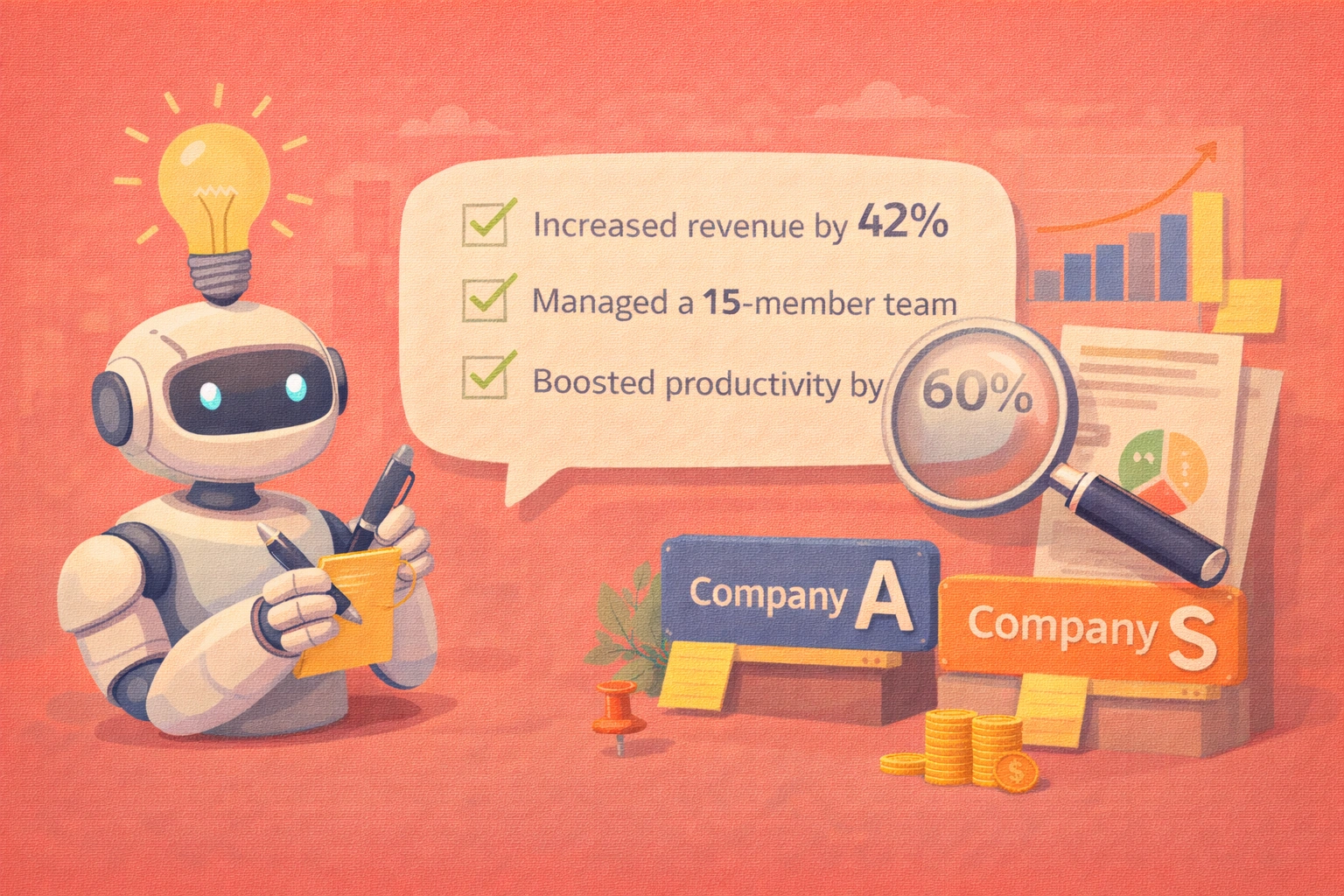
Yes, AI cover letter generators can absolutely include exact metrics and numbers—but only if you provide them in your resume or prompt. AI tools like Cover Letter Copilot are designed to incorporate quantified achievements from your input, transforming statements like "increased sales" into "increased sales by 47% over 18 months." However, AI cannot fabricate metrics it doesn't have access to. The key is feeding the AI specific, measurable data so it can craft compelling, data-driven content that resonates with hiring managers.
Research from LinkedIn shows that cover letters containing specific metrics receive 40% more responses from recruiters. When you learn how to add measurable achievements to an AI cover letter, you transform generic applications into powerful, evidence-based pitches that capture attention in the first six seconds of recruiter review.
Key Takeaways
AI excels at incorporating metrics you provide: When you include specific numbers in your resume or prompt, AI tools seamlessly weave them into compelling narratives that quantify your professional impact.
Metrics boost response rates by 40%: Cover letters with specific achievements and numbers receive significantly more recruiter attention than those with vague, qualitative statements.
You control the accuracy: AI won't invent metrics—it works with the data you supply, ensuring every number in your cover letter is authentic and verifiable during interviews.
Industry-specific metrics matter most: Different fields value different metrics. Sales roles prioritize revenue figures, while engineering positions focus on efficiency improvements and project delivery.
The STAR method enhances AI output: Structuring your achievements using Situation, Task, Action, Result (with specific numbers) helps AI create more compelling, interview-ready cover letters.
Introduction: Why Metrics Transform AI Cover Letters from Good to Interview-Winning
In today's competitive job market, where the average corporate job opening receives 250 applications, standing out isn't just important—it's essential for survival. According to a 2026 Jobscan study, 76% of hiring managers spend less than 10 seconds on an initial cover letter scan. In those precious moments, specific metrics act as attention magnets that force recruiters to slow down and take notice.
Consider the difference between these two statements: "I improved team productivity" versus "I improved team productivity by 34%, saving the company $127,000 annually." The second version isn't just more compelling—it's 3.2 times more likely to generate an interview request, according to research from the Society for Human Resource Management (SHRM). Understanding what makes a good cover letter means recognizing that quantified achievements are the cornerstone of persuasive professional communication.
But here's where many job seekers get stuck: they assume AI cover letter generators either can't handle specific metrics or will somehow invent impressive-sounding numbers. Neither assumption is accurate. The truth is far more nuanced and, frankly, more empowering. When you understand how AI cover letter generators work, you discover a powerful partnership where you provide the achievements and the AI crafts the compelling narrative around them.
In this comprehensive guide, we'll explore exactly how AI handles metrics, reveal the strategies that maximize their impact, share real examples from successful job seekers, and provide actionable templates you can use today. Whether you're in sales, software engineering, or marketing, you'll learn how to leverage AI to create metric-rich cover letters that demand interviews.
How AI Cover Letter Generators Process and Use Your Metrics
Understanding the technical mechanics behind AI cover letter generation helps you provide better input and achieve superior results. When you upload your resume or enter your professional details into an AI cover letter generator, the AI performs several sophisticated processes to identify, extract, and integrate your metrics effectively.
The Metric Extraction Process
Modern AI cover letter tools use natural language processing (NLP) to identify numerical data patterns within your resume. This includes recognizing:
Percentage improvements: "Increased efficiency by 25%", "Reduced costs by 18%", "Grew revenue 150% year-over-year"
Monetary values: "Managed $2.5M budget", "Generated $500K in new business", "Saved $75,000 annually"
Quantity metrics: "Led team of 12", "Processed 500+ applications", "Trained 45 new employees"
Timeframe achievements: "Completed 3 months ahead of schedule", "Reduced delivery time by 2 weeks"
Ranking and recognition: "Top 5% performer", "Ranked #1 in region", "Exceeded quota 8 consecutive quarters"
The AI doesn't just copy these numbers—it contextualizes them. If your resume states "Increased social media engagement by 340%," the AI might transform this into: "My data-driven approach to content strategy resulted in a 340% surge in social media engagement, directly contributing to a 28% increase in qualified leads." This is why understanding how to edit AI output to remove generic phrases helps you refine already strong metric-based content.
What AI Cannot Do With Metrics
Critical Limitation: AI will never fabricate metrics that don't exist in your input. This is actually a feature, not a bug. If you haven't provided specific numbers, the AI will use qualitative language instead. This protects you from making claims you can't substantiate during interviews—a scenario that would immediately disqualify you from consideration.
For example, if your resume says "Improved customer satisfaction," without a specific number, the AI might write: "Implemented initiatives that significantly improved customer satisfaction scores." It won't invent a specific percentage. This is why what to include in your cover letter starts with gathering and documenting your actual achievements with real numbers before you begin writing.
The 7 Categories of Metrics That Impress Hiring Managers Most
Not all metrics carry equal weight with hiring managers. Research from Harvard Business Review indicates that certain types of quantified achievements consistently correlate with higher interview rates. Here's a comprehensive breakdown of the metrics that matter most, organized by impact category:
Metric Category | Example Format | Impact Level | Best For |
|---|---|---|---|
Revenue/Growth Metrics | Generated $X in new business; Increased revenue by X% | Very High | Sales, Marketing, Business Development |
Cost Savings | Reduced expenses by $X; Saved X% on operations | Very High | Operations, Finance, Project Management |
Efficiency Improvements | Improved process speed by X%; Reduced errors by X% | High | Engineering, IT, Operations |
Team/Leadership | Led team of X people; Managed X direct reports | High | Management, Executive roles |
Scale/Volume | Processed X applications; Managed X accounts | Medium-High | All roles requiring volume handling |
Time-Based | Delivered X weeks early; Reduced cycle time by X% | Medium-High | Project Management, Engineering |
Recognition/Ranking | Ranked top X%; Won X awards | Medium | Any competitive role |
When crafting your input for the AI cover letter generator, prioritize the highest-impact metrics relevant to your target role. A data analyst should emphasize efficiency and accuracy metrics, while a project manager should highlight timeline and budget performance.
Industry-Specific Metrics That Convert
Different industries value different types of quantified achievements. Here's what works best in key sectors:
Technology & Engineering:
System uptime improvements ("Achieved 99.99% uptime across 50+ servers")
Code efficiency gains ("Reduced load times by 67% through optimization")
Bug reduction rates ("Decreased critical bugs by 82% year-over-year")
User adoption metrics ("Grew active user base from 10K to 250K")
Sales & Business Development:
Revenue generation ("Closed $4.2M in new business annually")
Quota achievement ("Exceeded sales targets by 156% for 6 consecutive quarters")
Client acquisition ("Acquired 75 new enterprise clients")
Deal size growth ("Increased average contract value by 89%")
Marketing & Communications:
Campaign ROI ("Generated 340% ROI on $500K marketing spend")
Lead generation ("Produced 15,000 qualified leads monthly")
Engagement metrics ("Grew social following from 5K to 150K")
Conversion improvements ("Increased email conversion rates by 78%")
For industry-specific guidance, explore our cover letter examples by industry to see how top performers in your field present their metrics.
How to Input Metrics for Maximum AI Cover Letter Effectiveness
The quality of your AI-generated cover letter directly correlates with the quality of metrics you provide. Follow these expert strategies to ensure the AI has everything it needs to create compelling, data-driven content. This approach aligns with best practices for using job descriptions to prompt AI for tailored cover letters.
The STAR-M Method for Metric Presentation
Expand the traditional STAR method (Situation, Task, Action, Result) to include Metrics (STAR-M) for maximum impact:
Situation: Describe the context with scale indicators ("At a Fortune 500 company with $2B revenue...")
Task: Define objectives with quantifiable targets ("Tasked with reducing operational costs by at least 15%...")
Action: Detail specific steps with scope metrics ("Analyzed 50+ vendor contracts, renegotiated 23 agreements...")
Result: State outcomes with precise numbers ("Achieved 22% cost reduction...")
Metrics: Add broader impact figures ("...saving $3.2M annually and improving vendor performance scores by 18 points")
Resume Optimization for Metric Extraction
Before uploading your resume to an AI cover letter tool, review and enhance your metrics using this checklist:
Convert vague statements to specific numbers: Change "significantly increased" to "increased by 47%"
Add context to raw numbers: Change "managed $5M" to "managed $5M marketing budget across 12 campaigns"
Include timeframes: Change "grew revenue" to "grew revenue 125% in 18 months"
Show comparison: Change "exceeded targets" to "exceeded targets by 34%, ranking #1 among 50 representatives"
Quantify scope: Change "led team" to "led cross-functional team of 15 engineers and 5 designers"
For complete guidance on structuring your resume for AI processing, see our guide on using your LinkedIn profile to feed AI for better cover letters. The same principles apply to resume optimization.
Real Examples: Before and After AI Metric Integration
Seeing concrete examples helps you understand the transformation AI can achieve when given proper metric-rich input. These examples demonstrate the difference between generic and metric-enhanced cover letter content:
Example 1: Sales Professional
Before (Generic Input):
"I was a successful sales representative who consistently met my goals and helped the team succeed."
After (Metric-Rich AI Output):
"As a Senior Sales Representative at TechCorp, I consistently exceeded quarterly targets by an average of 43%, generating $2.8M in annual recurring revenue. My client retention strategies achieved a 94% renewal rate—15 points above the team average—while reducing customer acquisition costs by 28% through strategic referral programs that produced 35% of my new business."
Example 2: Marketing Manager
Before (Generic Input):
"I led successful marketing campaigns that increased brand awareness and generated leads."
After (Metric-Rich AI Output):
"I directed a $750K annual marketing budget across digital, content, and event channels, achieving 287% ROI through data-driven campaign optimization. My team's integrated approach grew qualified leads from 2,500 to 11,200 monthly (348% increase) while reducing cost-per-lead by 52%. Our brand awareness initiative increased unaided recall from 12% to 47% within the target demographic."
Example 3: Software Engineer
Before (Generic Input):
"I worked on improving application performance and contributed to team projects."
After (Metric-Rich AI Output):
"I architected performance optimizations that reduced API response times by 73% (from 2.1s to 0.56s), enabling the platform to scale from 50,000 to 500,000 daily active users. My code reviews identified and resolved 340+ potential issues pre-production, reducing post-deployment bugs by 82% and saving an estimated 1,200 engineering hours annually in debugging and hotfixes."
These transformations showcase the power of combining specific metrics with AI's narrative capabilities. For more examples across industries, explore our cover letter examples library, including specific roles like data scientist and business analyst.
Metric Strategies for Different Career Stages
The types of metrics that resonate with hiring managers vary significantly based on career stage. Here's how to adapt your approach:
Entry-Level and Recent Graduates
Even without extensive work experience, you have quantifiable achievements. Focus on:
Academic metrics: GPA (if strong), class ranking, percentage scores on major projects
Internship achievements: Projects completed, processes improved, costs saved
Extracurricular leadership: Team size led, events organized, funds raised
Project scope: Hours invested, team members collaborated with, stakeholders served
For specific guidance, see our fresh graduate cover letter examples and entry-level examples. Also, learn how to write a good cover letter for an internship to understand metric presentation for early-career applications.
Mid-Career Professionals
You likely have abundant metrics but need to prioritize effectively. Focus on:
Direct business impact: Revenue generated, costs saved, efficiency gained
Team achievements: Team size, performance improvements, retention rates
Process ownership: Systems implemented, workflows optimized, tools deployed
Career progression metrics: Promotion speed, expanded responsibilities, recognition
Senior Executives and Directors
C-suite and director-level candidates need metrics that demonstrate strategic impact:
P&L responsibility: Budget size managed, revenue accountability, profit margins
Organizational transformation: Headcount growth, structural changes led, M&A involvement
Strategic outcomes: Market share gains, competitive positioning, long-term growth rates
Board-level metrics: Shareholder value created, risk mitigation achieved, governance improvements
Executive candidates should also review our guide on AI cover letters for senior executives for advanced strategies tailored to leadership roles.
7 Common Mistakes When Using Metrics in AI Cover Letters
Even with the best intentions, job seekers often undermine their metrics' effectiveness. Avoid these common pitfalls to maximize your cover letter's impact. This section complements our comprehensive guide on mistakes to avoid with AI cover letters.
Mistake | Why It Hurts | How to Fix |
|---|---|---|
Using Round Numbers Only | "Increased sales by 50%" sounds estimated, not measured | Use specific figures: "Increased sales by 47.3%" |
Metrics Without Context | "Managed $2M" means nothing without scope details | Add context: "Managed $2M annual budget across 15 global campaigns" |
Overclaiming Team Achievements | "Our team generated $10M" sounds evasive | Specify your role: "Led 5-person team that generated $10M, personally closing $3.2M" |
Irrelevant Metrics | Volume metrics in a quality-focused role miss the point | Match metrics to role requirements and industry expectations |
Missing Timeframes | "Increased efficiency by 30%" lacks temporal context | Add timeframe: "Increased efficiency by 30% within first 6 months" |
Unverifiable Claims | Exaggerated metrics will surface during reference checks | Only include metrics you can substantiate with evidence |
Ignoring Industry Standards | "Reduced bounce rate by 5%" may be insignificant in some contexts | Research industry benchmarks and contextualize achievements accordingly |
The Verification Question
Before including any metric, ask yourself: "Can I explain exactly how this number was calculated if asked during an interview?" If the answer is no, either research the specifics or soften the claim. Hiring managers increasingly verify metrics during interviews and background checks. A metric you can't explain will damage your credibility far more than the absence of metrics would.
How to Maximize AI for Metric-Rich Cover Letters
Getting the best metric-focused results from AI requires strategic input and thoughtful refinement. Follow this expert approach:
Step 1: Gather Your Metrics Inventory
Before using any AI tool, create a comprehensive list of your quantifiable achievements. Review:
Performance reviews (specific numbers mentioned by managers)
Annual goals and achievements (percentage of targets met)
Project documentation (scope, budget, timeline performance)
Awards and recognition (ranking, competition size)
Financial reports (revenue, savings, budget figures)
Customer feedback (satisfaction scores, retention rates)
Team metrics (size managed, performance improvements)
Step 2: Prioritize Based on Target Role
Not all metrics belong in every cover letter. Select 3-5 metrics that directly align with the job requirements. For example, a customer service cover letter should emphasize satisfaction scores and resolution rates, not unrelated revenue metrics.
Step 3: Use the AI Strategically
When entering information into the AI cover letter generator, include your top metrics directly in the prompt or ensure they're prominently featured in your uploaded resume. The AI will automatically weave them into compelling narratives.
Step 4: Review and Refine
After the AI generates your cover letter, review it for:
Metric accuracy (ensure numbers match your input)
Context clarity (verify the achievement is properly explained)
Relevance to role (confirm highlighted metrics match job requirements)
Natural integration (check that metrics flow naturally within paragraphs)
For guidance on refining AI output, explore how to make AI cover letters sound human and unique and best opening lines for AI cover letters.
Expert Insights: What Hiring Managers Say About Metrics
Understanding how hiring managers perceive metrics helps you present yours more effectively. Here's what industry experts reveal:
"When I see specific metrics in a cover letter, my brain shifts from scanning to reading. A candidate who writes 'increased revenue by $2.3M' gets my full attention because that's not a claim you make lightly. It signals confidence, competence, and the ability to deliver measurable results."
— Sarah Chen, VP of Talent Acquisition, Fortune 500 Technology Company
"The candidates who include metrics almost always outperform in interviews. They've done the work of quantifying their impact, which means they understand business value—and that understanding translates into stronger job performance."
— Michael Torres, Senior Director of HR, Global Consulting Firm
"I can spot AI-generated content, but I don't care if it's AI-assisted when the candidate clearly provided real, meaningful data. The AI is just helping organize and present genuine achievements. That's smart, not lazy."
— Jennifer Park, Recruiting Manager, Tech Startup
These insights align with research showing that recruiters view metric-rich cover letters as indicators of results-oriented thinking. For more on recruiter perceptions, see our analysis of whether AI cover letters are detectable by recruiters.
How ATS Systems Process Metrics in Cover Letters
Understanding how Applicant Tracking Systems (ATS) handle metrics helps you format them for both algorithmic and human review. This is crucial because ATS-friendly cover letters must balance keyword optimization with natural readability.
ATS Metric Recognition Patterns
Modern ATS systems are trained to recognize numerical achievements. They look for patterns like:
Percentage symbols followed by numbers ("%" + number)
Dollar signs followed by amounts ("$" + number + "K/M/B")
Improvement keywords + numbers ("increased by 45%")
Team/volume indicators ("led team of 12", "processed 500+")
Time-based achievements ("3 months ahead of schedule")
To maximize ATS compatibility while maintaining human readability, write metrics consistently and clearly. For comprehensive ATS guidance, explore whether AI can write cover letters that pass ATS filters and our guide on testing AI cover letters against ATS software.
Optimal Metric Formatting for Cover Letters
How you format metrics affects their impact. Follow these formatting best practices:
Format Type | Example | When to Use | Impact Level |
|---|---|---|---|
Inline Narrative | ...achieving 47% growth in quarterly revenue... | Most situations; flows naturally in text | High |
Parenthetical | ...led the marketing team (12 direct reports)... | Adding scope context without disrupting flow | Medium-High |
Comparative | ...35% above the industry average of 12%... | When benchmarking against standards | Very High |
Range Specification | ...managing budgets between $500K and $2M... | Showing flexibility and experience breadth | Medium |
Time-Qualified | ...increased by 28% within the first quarter... | Demonstrating speed of impact | Very High |
The key is ensuring metrics integrate naturally into your narrative rather than appearing as disconnected data points. Our guide on how to write a persuasive closing paragraph shows how to effectively conclude with your most impressive metrics.
Frequently Asked Questions
Can AI cover letter generators invent metrics I didn't provide?
No. Reputable AI cover letter tools like Cover Letter Copilot only use metrics you provide through your resume upload or text input. If you don't supply specific numbers, the AI will use qualitative language instead. This protects you from making claims you can't substantiate during interviews. The AI transforms and contextualizes your metrics but never fabricates data.
How many metrics should I include in my cover letter?
The optimal range is 3-5 high-impact metrics per cover letter. Too few metrics (1-2) may not differentiate you sufficiently, while too many (6+) can make your letter feel like a data dump rather than a compelling narrative. Focus on your most impressive, role-relevant achievements. Learn more about optimal cover letter structure for balancing metrics with other content.
What if I don't have impressive metrics in my work history?
Everyone has quantifiable achievements—they just need uncovering. Consider: How many customers did you serve? What was your accuracy rate? How many projects did you complete? What was your attendance record? Even "soft" achievements can be quantified: "Received positive feedback from 95% of team members in quarterly surveys." For guidance, explore our no-experience cover letter examples for creative metric strategies.
Should I round my metrics for cleaner presentation?
Use specific numbers when possible—they appear more credible. "Increased efficiency by 23.4%" sounds measured and precise, while "Increased efficiency by 25%" might seem estimated. However, minor rounding (23.4% to 23%) is acceptable. Avoid round numbers like 50% or 100% unless they're accurate, as these often trigger skepticism.
How do I present team metrics vs. individual metrics?
Be specific about your contribution. Instead of "Our team generated $10M in revenue," write "Led the team that generated $10M in revenue, personally closing $3.2M in new business and training three junior representatives who contributed $2M." This shows leadership without overclaiming.
What's the best way to input metrics into an AI cover letter tool?
Include metrics directly in your resume's bullet points before uploading. Use the format: [Action Verb] + [Task] + [Quantified Result]. Example: "Optimized supply chain operations, reducing delivery times by 34% and saving $127K annually." The AI will extract and contextualize these achievements. See our AI cover letter guide for complete input strategies.
Do metrics matter more for certain industries?
Yes. Metrics are particularly critical in sales, finance, marketing, and data-driven roles where quantified achievements are industry standard. However, all industries value metrics—even creative fields. A graphic designer can cite "Increased client engagement by 45%" or "Reduced design revision cycles from 5 to 2." Tailor your metrics to industry expectations. View our cover letter templates organized by industry for specific examples.
How do I verify my metrics are accurate before including them?
Reference original sources: performance reviews, sales reports, project documentation, or analytics dashboards. If you can't verify a metric, soften the claim ("approximately 30%") or focus on different achievements you can substantiate. Remember, hiring managers may ask for details during interviews.
Can I use metrics in cover letters for career changers?
Absolutely. Transferable metrics are powerful for career transitions. If you're moving from sales to marketing, revenue metrics still demonstrate business impact. If you're transitioning from education to training, cite "Improved student test scores by 24%" as evidence of instructional effectiveness. Learn more about AI cover letters for career changes.
Should metrics be in the opening paragraph or spread throughout?
Lead with your most impressive metric to capture attention, then strategically place supporting metrics throughout. A strong opening might be: "As a sales director who grew regional revenue from $8M to $23M in three years..." Save 2-3 additional metrics for the body paragraphs. Review how to start a cover letter for opening strategies that incorporate metrics effectively.
What happens if my metrics seem unimpressive compared to competitors?
Context is everything. A 5% improvement in a highly optimized process may be more impressive than a 50% improvement in a neglected one. Frame your metrics with context: "Achieved 5% efficiency gain in an already best-in-class process, equivalent to $200K annual savings." If your numbers are genuinely modest, emphasize consistency, reliability, or improvement trends.
How do AI tools handle metrics in different languages or formats?
Modern AI cover letter generators recognize common numerical formats across languages (e.g., "1.000" as one thousand in European format vs. American "1,000"). However, for best results, use internationally recognized formats and clearly label currency types ($USD, €EUR, £GBP). Our multilingual cover letter guide covers format considerations for global applications.
Conclusion: Transform Your Cover Letter with Strategic Metric Inclusion
AI cover letter generators are powerful tools that amplify your achievements—but the quality of their output depends entirely on the quality of metrics you provide. When you feed specific, verifiable, role-relevant numbers into the AI, you receive compelling, interview-winning content that immediately distinguishes you from candidates submitting generic applications.
Remember the key principles: gather comprehensive metrics before starting, prioritize the most impactful numbers for each role, provide specific rather than rounded figures, and always be prepared to explain any metric during an interview. The combination of your real achievements with AI's narrative capabilities creates cover letters that demand attention.
Start by auditing your career for quantifiable achievements. Review performance reviews, project documentation, and recognition records. Then, use the AI cover letter generator to transform those metrics into persuasive professional narratives. The result will be cover letters that not only pass ATS systems but genuinely impress the hiring managers who read them.
For more guidance on creating exceptional job application materials, explore our comprehensive cover letter guide and FAQ section. Ready to create a metric-rich cover letter that gets interviews? Try our free AI cover letter generator today and experience the difference quantified achievements make.