

What Tone Should an AI Cover Letter Use for Creative Roles?

TL;DR - Quick Answer
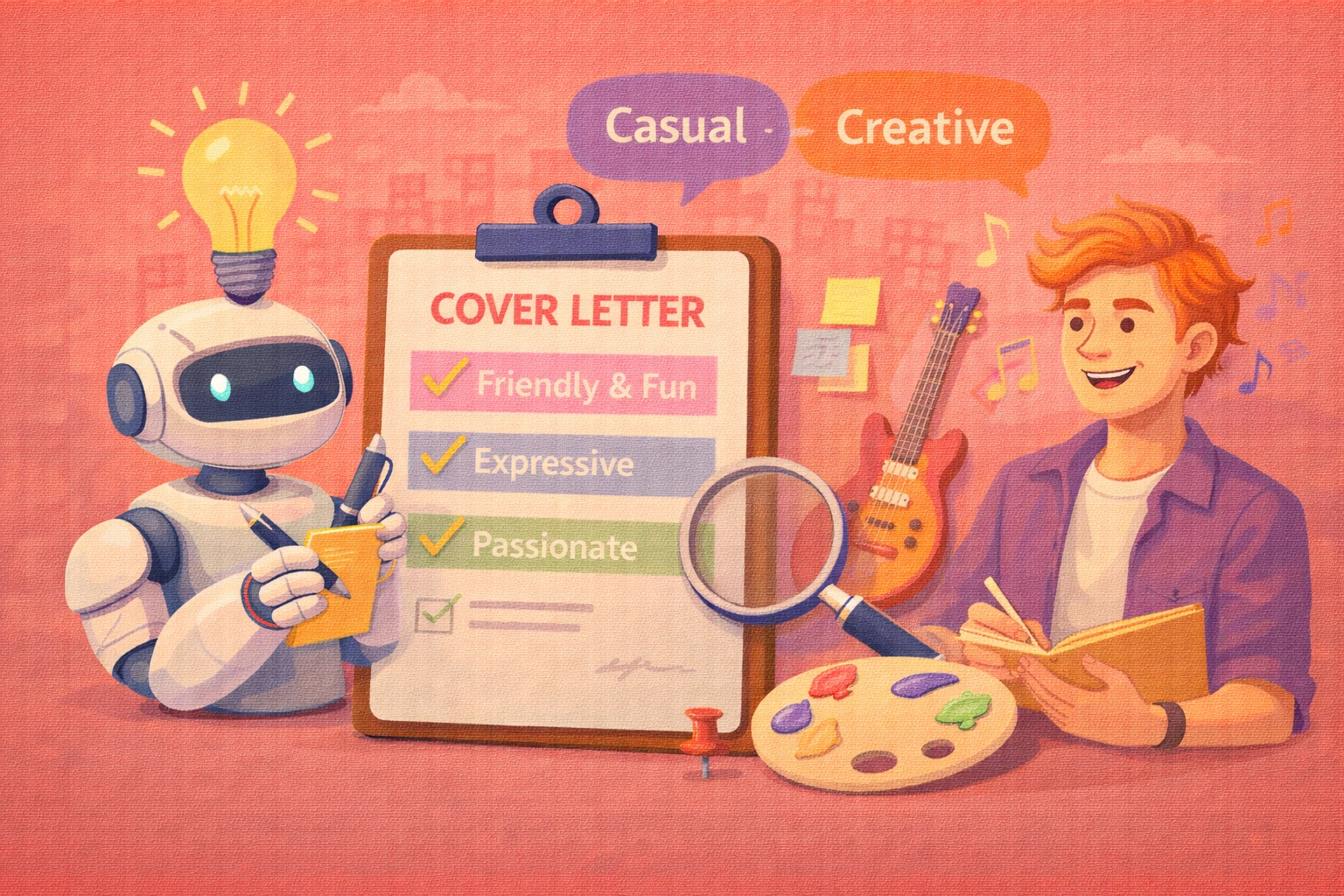
AI cover letters for creative roles should balance professional competence with authentic personality and creative flair. The ideal tone is confident yet approachable, demonstrates creative thinking in the writing itself, and feels distinctly human rather than templated. Avoid overly formal corporate language while maintaining professionalism—creative directors and hiring managers expect your cover letter to be a sample of your creative communication skills.
The key is calibrating your tone to the specific creative field: a graphic design agency expects visual thinking reflected in concise, punchy language, while a content marketing role might appreciate wit and storytelling. When you understand how to make AI cover letters sound human and unique, you can transform generic AI output into compelling creative applications that showcase your personality and skill simultaneously.
Key Takeaways
Match energy to the company: Research the brand voice of your target company and mirror that energy—a startup wants different vibes than a legacy agency.
Show, don't tell creativity: Demonstrate creative thinking through your word choices, structure, and storytelling rather than just claiming to be creative.
Balance confidence with authenticity: Creative hiring managers value genuine personality over polished perfection—let your real voice come through.
Avoid AI detection flags: Generic, overly formal phrases immediately signal automated content to creative professionals who review applications daily.
Lead with creative hooks: Your opening sentence should capture attention the same way your creative work would—make it memorable.
Why Tone Matters More for Creative Roles
In most industries, cover letter tone follows predictable professional conventions. Creative industries operate differently. When you apply for a designer, copywriter, art director, or content creator position, your cover letter isn't just an introduction—it's your first creative sample. Hiring managers evaluate not just what you say, but how you say it.
This creates both opportunity and challenge for AI-assisted cover letters. The efficiency of AI generation can produce polished, professional content, but creative roles demand something more: a distinctive voice that signals you belong in a creative environment. Generic AI output—no matter how grammatically perfect—often fails this test.
This guide explores exactly what tone works for creative role applications, how to prompt AI for that tone, and the crucial editing steps that transform competent content into compelling creative communication. Whether you're targeting graphic design positions, marketing roles, or content creation opportunities, you'll learn to craft AI-assisted letters that resonate with creative hiring managers.
Understanding the Creative Tone Spectrum
Creative roles span a wide spectrum, and the appropriate tone varies significantly. Understanding where your target role falls helps you calibrate your approach.
Creative Role Type | Tone Characteristics | What to Avoid |
|---|---|---|
Advertising Agency (Creative) | Bold, witty, confident, conceptual thinking | Corporate formality, clichés, safe choices |
Design Studio (Visual) | Clean, precise, conceptually driven, visual language | Overly wordy, vague descriptions |
Content/Copywriting | Conversational, storytelling, brand-voice aware | Stiff academic language, jargon overload |
UX/Product Design | User-focused, problem-solving oriented, clear | Abstract creativity without practical grounding |
Marketing Creative | Persuasive, data-informed, audience-aware | Pure artistic focus without business context |
Media/Entertainment | Engaging, culturally aware, personality-forward | Dry, corporate, personality-free |
The common thread across all creative roles: authenticity and personality matter. Creative hiring managers can detect inauthenticity instantly—they evaluate creative work for a living. Your cover letter must feel like a real person wrote it, not an algorithm. Learn strategies for achieving this in our guide on how to make your cover letter more engaging.
Core Tone Elements for Creative Cover Letters
1. Confident Without Arrogance
Creative professionals respect confidence—you're selling your creative vision along with your skills. But there's a line between confidence and arrogance that creative communities are particularly sensitive to.
Confident: "My recent campaign for [Brand] increased engagement 340%—I'd love to bring that strategic creativity to your team."
Arrogant: "As one of the top creatives in my field, I would be doing your agency a favor by joining."
Underconfident: "I hope you might consider me for this position if you think I could possibly be qualified."
The sweet spot shows capability through evidence while respecting the reader. For more on presenting achievements effectively, see our guide on how to add measurable achievements to an AI cover letter.
2. Conversational Yet Professional
Creative cover letters can—and often should—break traditional formality rules. But conversational doesn't mean casual or sloppy. It means writing like a skilled communicator talks: clear, engaging, and purposeful.
Use contractions naturally: "I'm" reads better than "I am" in creative contexts
Vary sentence length: Mix punchy short sentences with longer explanatory ones
Allow personality phrases: "Here's the thing..." or "What excites me most..." can work beautifully
Avoid stuffiness: Skip "I am writing to express my interest in" for something more direct
Creative agencies particularly appreciate cover letters that demonstrate the communication skills they'll need on the job. For strong openings, explore our best opening lines for AI cover letters.
3. Personality-Forward Without Unprofessional
Your personality is a selling point in creative roles. Hiring managers want to work with interesting people. But personality should enhance professionalism, not replace it.
Personality done right: "I've spent five years turning complex ideas into scroll-stopping visuals—and getting mildly obsessed with kerning along the way."
Personality overdone: "LOL I'm basically addicted to design! My friends say I need help because I can't stop talking about typography haha."
The first example shows personality while maintaining credibility. The second undermines professional positioning. For more on this balance, see how to personalize AI output with a professional anecdote.
4. Creative in Execution, Not Just Claims
The cardinal sin of creative cover letters: claiming to be creative without demonstrating it. Telling someone you're creative while writing generic copy is self-defeating.
Telling (Weak) | Showing (Strong) |
|---|---|
I am a creative thinker | The brief said 'safe.' I pitched a campaign that put our client's CEO in a giant hamster ball. It won a Clio. |
I have strong writing skills | Every headline I write passes what I call the 'would-I-stop-scrolling' test. Here's why that matters for [Company]... |
I'm passionate about design | I spent my weekend reverse-engineering your latest rebrand—here's what I noticed about your typography choices... |
I think outside the box | When traditional A/B testing stalled, I proposed testing emotional triggers instead of visual elements. Conversions jumped 47%. |
Tone Guidance by Creative Industry
Advertising and Marketing Agencies
Ad agencies value conceptual thinking, boldness, and cultural awareness. Your cover letter should feel like a creative brief executed well—strategic yet surprising.
Lead with a hook that demonstrates creative thinking
Reference specific campaigns or work you admire from their portfolio
Show you understand both creative excellence and client service
Demonstrate awareness of industry trends and cultural moments
Keep it concise—ad people appreciate economy of words
Example opening: "Your 'Midnight Snack' campaign made me laugh, then made me hungry, then made me think about brand storytelling differently. That's the kind of work I want to make—and I have the strategic chops to help you make more of it."
Design Studios and Agencies
Designers appreciate precision, intentionality, and visual thinking reflected in clear communication. Your cover letter should demonstrate the same attention to detail you'd bring to design work.
Be precise with language—every word should earn its place
Structure your letter with clear visual hierarchy (in text form)
Reference specific design decisions you noticed in their work
Show understanding of design process, not just final outputs
Demonstrate you can translate complex concepts into clear communication
For design-specific examples, explore our graphic designer cover letter examples.
Content and Copywriting Roles
Your cover letter IS your writing sample. Content roles demand cover letters that showcase exactly the skills you'll use on the job: engaging writing, audience awareness, and brand voice flexibility.
Match your writing style to the company's content voice
Tell a micro-story that demonstrates narrative ability
Show you understand content strategy, not just content creation
Reference specific pieces from their content you connected with
Demonstrate range if they produce varied content types
For content role strategies, see our guide on how to make AI cover letters match company style or tone.
UX and Product Design
UX roles blend creativity with problem-solving. Your tone should demonstrate both design thinking and user empathy—creative solutions grounded in real user needs.
Frame your creativity in terms of user problems solved
Show you understand research-informed design
Balance creative vision with practical implementation
Reference specific UX challenges in their product you'd love to tackle
Demonstrate systems thinking alongside creative execution
How to Prompt AI for Creative Tone
Getting the right tone from AI requires specific prompting. Generic prompts produce generic output. Here's how to guide AI toward appropriately creative content.
Effective Creative Prompts
When using an AI cover letter generator or tools like ChatGPT, include these elements in your prompts:
Specify the creative industry: "I'm applying to a boutique advertising agency known for bold, conceptual campaigns"
Define the desired voice: "Use a confident, conversational tone that shows personality without being unprofessional"
Request creative structure: "Open with a hook that demonstrates creative thinking, not a standard introduction"
Ask for specificity: "Include specific references to their work that show I've done my research"
Avoid generic phrases: "Do not use phrases like 'I am excited to apply' or 'I believe I would be a great fit'"
For more advanced prompting techniques, review our complete guide on how to use ChatGPT for cover letter prompts.
Sample Prompt for Creative Roles
"Write a cover letter for a Senior Copywriter position at [Creative Agency]. The agency is known for witty, culturally relevant campaigns. Use a confident, personality-forward tone that demonstrates creative thinking in the writing itself. Open with a creative hook—not a standard introduction. Reference their recent [Campaign Name] and explain what I admire about it. Include my experience writing campaigns that achieved [specific metric]. Avoid corporate jargon and generic enthusiasm phrases. The letter should feel like it was written by someone who belongs in a creative environment."
Essential Edits to Transform AI Output
Even well-prompted AI typically requires editing to achieve truly creative tone. Here's how to refine AI output for creative applications.
Remove AI Tells That Undermine Creativity
Creative hiring managers are particularly attuned to inauthentic content. Remove these common AI patterns:
AI Pattern to Remove | Creative Alternative |
|---|---|
I am writing to express my interest in... | Your Midnight campaign made me rethink everything about snack advertising... |
I believe I would be a great fit... | Here's what I'd bring to your creative team... |
I am excited about this opportunity... | The chance to work on [specific type of work] is exactly what I've been looking for... |
With my extensive experience in... | Five years of turning complex briefs into award-winning work taught me... |
I am confident that my skills... | My campaigns have [specific result]—and I'm ready to do the same for you. |
For comprehensive editing strategies, see how to edit AI output to remove generic phrases.
Add Creative Elements AI Often Misses
Industry-specific references: Name recent campaigns, design trends, or creative movements relevant to your field
Micro-stories: Brief narrative moments that bring your experience to life
Genuine opinion: Creative professionals appreciate perspective—share a real point of view
Specific observation: Something only you would notice about their work
Self-aware humor: When appropriate, a touch of wit shows creative sensibility
Check for Consistent Voice
AI sometimes shifts voice within a single piece. Review your letter for consistency:
Does the opening energy match the closing?
Are there sudden shifts from casual to formal language?
Does every paragraph sound like the same person?
Would you actually talk this way in a creative review?
Expert Perspectives on Creative Cover Letter Tone
"When I review creative portfolios, the cover letter tells me if someone actually belongs in a creative environment. Generic AI-sounding letters go straight to the 'no' pile—not because we're anti-AI, but because someone applying for a creative role should understand that communication IS creative work. If your cover letter sounds like it could be from anyone, why would I believe your creative work will be distinctive?"
— Marcus Webb, Executive Creative Director, Award-Winning Advertising Agency
"The best cover letters I receive feel like conversations with interesting people. They show personality without trying too hard. They reference specific work we've done—not generic praise, but actual observations. They demonstrate the candidate can write, which is half the job. AI can help with structure and ideas, but the final product needs a human fingerprint."
— Sarah Chen, Content Director, Digital Media Company
"I can forgive a lot in a cover letter if it makes me smile or think. I cannot forgive boring. Creative roles demand people who bring energy and ideas. Your cover letter is proof of concept—show me you can make something engaging even when the format is constrained."
— James Rodriguez, Design Director, Brand Strategy Studio
These perspectives align with research on successful creative applications. Explore real-world examples in our case studies of AI-generated cover letters that got interviews.
Common Tone Mistakes in Creative Cover Letters
Mistake | Why It Fails | Better Approach |
|---|---|---|
Overly casual/jokey | Undermines professional credibility | Personality with purpose—humor that serves the message |
Corporate formality | Signals wrong cultural fit for creative environment | Conversational professionalism |
Self-deprecating humor | Weakens your positioning as a candidate | Confident authenticity |
Trying too hard to be clever | Feels forced, like creativity theater | Natural creative expression |
Generic creative claims | "I'm creative" without proof | Demonstrated creativity in the writing |
Ignoring company voice | Shows lack of research and adaptability | Mirror their energy appropriately |
All style, no substance | Creative without strategic substance | Creative expression of genuine qualifications |
For broader guidance on avoiding errors, see mistakes to avoid when using AI to write a cover letter.
Creative Tone Checklist
Before sending your creative cover letter, verify these elements:
Tone and Voice
Does it sound like a real creative professional, not an algorithm?
Is there genuine personality without unprofessionalism?
Does the energy match the target company's culture?
Would you be comfortable reading this aloud in an interview?
Does every paragraph sound like the same person wrote it?
Creative Demonstration
Does the writing itself demonstrate creative thinking?
Is there at least one memorable, distinctive moment?
Did you show creativity rather than just claim it?
Does the opening hook capture attention immediately?
Is the closing memorable, not generic?
For strong closings, see how to write a persuasive closing paragraph in an AI cover letter.
Research and Specificity
Do you reference specific work from the target company?
Is there evidence you understand their creative approach?
Have you shown why you specifically fit their culture?
Are your examples relevant to their type of creative work?
AI Detection Prevention
Have you removed all generic AI phrases?
Does the sentence structure vary naturally?
Are there unique observations only you would make?
Does it include specific details from your real experience?
Frequently Asked Questions
Can creative cover letters be too informal?
Yes. While creative roles tolerate—even expect—less formal communication, there's still a line. Avoid slang, excessive exclamation points, or humor that could be misread. The goal is conversational professionalism: relaxed enough to show personality, structured enough to demonstrate competence. When in doubt, err slightly toward professional.
Should I use humor in a creative cover letter?
Humor can work beautifully when it's natural to your voice and relevant to the context. A witty observation about their work or a self-aware aside can humanize your application. But forced humor or jokes for their own sake often backfire. If humor isn't your strength, authentic enthusiasm works just as well.
How creative should the formatting be?
For most applications, keep formatting conventional while making the writing creative. Unusual layouts or graphics can cause ATS issues and may seem like you're compensating for content. Exception: if you're specifically applying for a visual design role AND submitting via email/PDF to a human, creative formatting might be appropriate. Learn more about ATS considerations in how to test AI cover letters against ATS.
How do I balance showing personality with discussing qualifications?
The best creative cover letters integrate personality and qualifications—your voice shines through while discussing your experience. Rather than a personality section and a qualifications section, weave personality into how you present your achievements. A creative way of describing real accomplishments serves both purposes.
Should I reference specific work from the company?
Absolutely. Creative professionals deeply appreciate when candidates engage with their actual work—not generic praise, but specific observations. Reference a particular campaign, design choice, or content piece and share what you noticed or admired. This demonstrates research, taste, and the analytical eye creative roles require.
How long should a creative cover letter be?
Creative cover letters can follow standard length guidelines (250-400 words) while being more impactful through better writing. Brevity is often appreciated in creative fields—showing you can communicate effectively without rambling. Every sentence should earn its place. For detailed length guidance, see what makes a good cover letter.
Is it okay to be unconventional in the opening?
For creative roles, unconventional openings are often welcomed—even expected. Starting with a bold statement, a specific observation about their work, or a creative hook demonstrates the thinking they'll need on the job. Just ensure your unconventional opening is strong; a failed creative attempt is worse than a straightforward professional opening. See examples at good sentence starters for cover letters.
Should I adapt my tone for different creative industries?
Definitely. An advertising agency expects different energy than a corporate in-house design team. Research the company's own communication style through their website, social media, and published work. Mirror that energy appropriately—a startup's irreverent brand voice calls for different tone than a luxury brand's sophisticated positioning.
Can AI really capture creative voice?
AI provides a strong foundation that requires human refinement for creative roles. It handles structure, grammar, and basic personalization well. The creative spark—unique observations, genuine personality, industry-specific nuance—typically needs human editing. Use AI to build the framework, then inject your creative perspective through editing.
How do I prove I'm creative without a portfolio link?
Your cover letter IS proof of your creative ability. The way you construct sentences, the observations you make, the personality you display—all demonstrate creative sensibility. A brilliantly written cover letter with no portfolio link is more compelling than a generic cover letter with an amazing portfolio link. Show your creativity in real-time.
What if the job posting seems very formal?
Some creative roles exist within more corporate environments. Read the job posting carefully for tone cues. If the posting itself is formal, dial back the conversational elements while maintaining creative quality in your writing. You can be creative and professional simultaneously—adapt to what the context suggests.
Should I mention that I used AI to help write my cover letter?
No. There's no need to disclose AI assistance, just as you wouldn't disclose that you used spell-check or asked a friend for feedback. What matters is that the final product represents you accurately. If you've edited the AI output to reflect your true voice and experience, it's your work.
Conclusion: Crafting AI Cover Letters That Resonate with Creative Hiring Managers
The tone of your creative cover letter can make or break your application. Creative hiring managers don't just evaluate qualifications—they evaluate how you communicate. Your cover letter is a preview of how you'd represent their brand, engage their audiences, and contribute to their creative culture.
The ideal tone balances several tensions: confident without arrogance, creative without gimmicky, personal without unprofessional, conversational without careless. AI provides an excellent foundation for this balance, but achieving truly resonant creative tone requires human editing that adds personality, specific observations, and authentic voice.
Remember that creative industries value distinctive voices. Generic AI output fails the fundamental test of creative roles: demonstrating that you bring something unique. Edit your AI-generated content to include specific references to the company's work, genuine personality expressions, and creative choices that showcase your thinking.
Start crafting your creative cover letter using the AI cover letter generator, then apply the editing techniques in this guide to achieve authentic creative tone. Explore our cover letter examples for inspiration across different creative fields, and review how to make a cover letter stand out for additional strategies. With the right tone, your AI-assisted cover letter will demonstrate exactly what creative employers want to see: that you can communicate with creativity, confidence, and authentic personality.
Last reviewed: September 2026